Vague prompts produce generic output because AI models fill every gap you leave with the most statistically common answer in their training. One structural fix changes everything.

Why Your AI Prompts Keep Producing Mediocre Output (And the Fix That Works Every Time)AI prompts produce mediocre output because vague instructions cause the model to fill every unspecified gap with the most statistically common answer in its training data. The fix is a five-part structure — Role, Context, Task, Format, Constraints — applied to every prompt before sending. This framework works across ChatGPT, Claude, and Gemini and produces measurably better output immediately.Why the Model Is Not the ProblemMost people blame the AI model when they get a disappointing output. The model is almost never the problem. The problem is that the model is executing exactly what it was given — a vague instruction — and producing the most average, broadly applicable response it can generate for that instruction.When you type "write me a blog post about hormones," the model has no information about your audience, your tone, your angle, your word count, your format, or what you actually want to say. It produces a blog post that would be appropriate for approximately no one in particular. It is technically correct. It is practically useless.The gap between what most people type and what they actually need is the entire problem. The five-part framework below closes it.The Five-Part Prompt Structure1. RoleTell the model exactly who it is for this task. Specificity determines output quality at this step more than at any other.Weak role: "Act as an expert."Strong role: "You are a senior content strategist with 12 years of experience writing for women's health brands targeting women aged 30-50 who are skeptical of conventional medicine and have tried multiple approaches without lasting results."The specificity of the role tells the model which knowledge layer to draw from, which assumptions to make about the reader, and which language register to use. A specific role produces targeted output. A vague role produces generic output.2. ContextGive the model the situational information it cannot infer. What is this for? Who will read it? What platform will it appear on? What constraints exist?Context does not need to be long. Three sentences of precise context outperform three paragraphs of vague background every time.3. TaskState the deliverable with precision. Specify the format, the length, the structure, and the purpose simultaneously.Weak task: "Write a social media post."Strong task: "Write one LinkedIn post under 200 words using short single-sentence paragraphs. Open with a counterintuitive statement. End with one question that professionals in this field would actually want to answer. No bullet points. No hashtag walls at the end."Every specification removes one degree of freedom the model would otherwise fill with a generic default.4. FormatIf format was not specified in the task, specify it here. Tell the model exactly how you want the output structured: headers or no headers, bullet points or prose, first person or third person, numbered steps or narrative, length in words or paragraphs or items.Format specifications are the most commonly skipped component and the one that most directly affects whether you can use the output without reformatting it.5. ConstraintsState what to exclude, what tone to avoid, what phrases the model should never use.Example constraint set: "Do not use the phrases 'it depends,' 'there are many factors,' or 'it is important to note.' Do not hedge before giving a recommendation. Do not use bullet points. Do not begin any sentence with 'Additionally.'"Adding constraints sounds like restriction. It functions as precision. The output becomes more direct immediately because the model's default hedging patterns have been explicitly removed.The Before and AfterBefore (weak prompt): "Give me marketing ideas for my ebook about hormones."After (five-part prompt): "You are a performance marketing specialist with 10 years of experience in direct-response digital marketing for health and wellness digital products. I sell an ebook on hormone balance for women aged 30-50 who are skeptical of conventional medicine and have tried multiple approaches without results. Give me 7 specific Pinterest marketing ideas that drive ebook sales, not brand awareness. Format as a numbered list. Each idea must include the pin title angle, the visual concept, and the call to action. Do not suggest generic tips that apply to any health product."Same request. Completely different output. The gap is entirely in the specification.The One Technique That Instantly Improves Any PromptAdd this line to the end of any prompt before sending:"Before you respond, ask me any clarifying questions that would help you give me a significantly better answer."This single sentence transforms the model from an instruction-executor into a collaborator. The questions it generates reveal what you forgot to specify. The answer it produces after your responses will be dramatically more targeted than anything produced from the original prompt alone.The Prompt Iteration MethodOne prompt rarely produces a final result. Iteration is the skill that separates users who get consistently excellent outputs from those who get occasional good ones.After your first output, send one follow-up using this structure: Keep: what worked in the previous output Remove: what did not work Add: what is missing Adjust: tone, length, specificity, or format Staying in the same conversation maintains context. The model builds on what already exists rather than starting from blank state. Three iterations of this sequence produce work that would take significantly longer to create manually.Context Engineering: The 2026 Evolution of PromptingThe evolution of prompt engineering in 2026 is context engineering: designing the entire information environment the model operates in rather than crafting individual prompts. This includes what the model knows about you, what role it is playing, what tools it has access to, and how its outputs feed back into subsequent prompts.For most individual users, this means one practical shift: stop treating each AI session as a standalone interaction. The context you establish in message one shapes everything that follows. A well-constructed first message with all five components is not overthinking. It is operating the model correctly.For ready-to-use prompt frameworks, templates, and before-and-after examples organized by use case, the full Prompt Professor guide library is available at promptprofessor.estorealm.com.Frequently Asked QuestionsDoes the five-part framework work for all AI models including ChatGPT, Claude, and Gemini? Yes. Claude responds particularly well to the Role and Constraints components and benefits from XML tag structure for complex prompts. ChatGPT handles ambiguous tasks more flexibly but benefits strongly from Format and Task specification. Gemini responds well to hierarchical context that moves from broad to specific. The five parts apply to all three. Formatting preferences within each component vary slightly by model.How long should a well-structured prompt be? Long enough to remove the guesswork and no longer. The measure is not word count. The measure is whether every gap that the model would otherwise fill with a generic default has been specified. Some tasks need two sentences. Others need two paragraphs. Both can be well-structured.Is there a point where adding more constraints hurts output quality? Yes. Over-constrained prompts can satisfy all stated requirements while missing the actual intent. Four to six constraints is the productive range for most tasks. Beyond eight, constraints can begin conflicting with each other. Specify what matters most, not everything.What is the single biggest prompt mistake most people make? Skipping the Role. The role is the context the model uses to calibrate every other decision in the output. Without a specific role, the model defaults to a generic helpful assistant producing a generic helpful response. With a specific role, it draws from a specific frame of reference that produces dramatically more targeted results.What is the difference between prompt engineering and context engineering? Prompt engineering focuses on crafting individual prompts for specific tasks. Context engineering, the 2026 evolution, focuses on designing the entire information environment the model operates in across a full session or application — including persistent custom instructions, tool access, memory, and how outputs feed back into subsequent inputs.This article is for educational purposes only. AI model behaviors evolve continuously. Test all techniques with your specific model and use case.
More from Prompt Professor
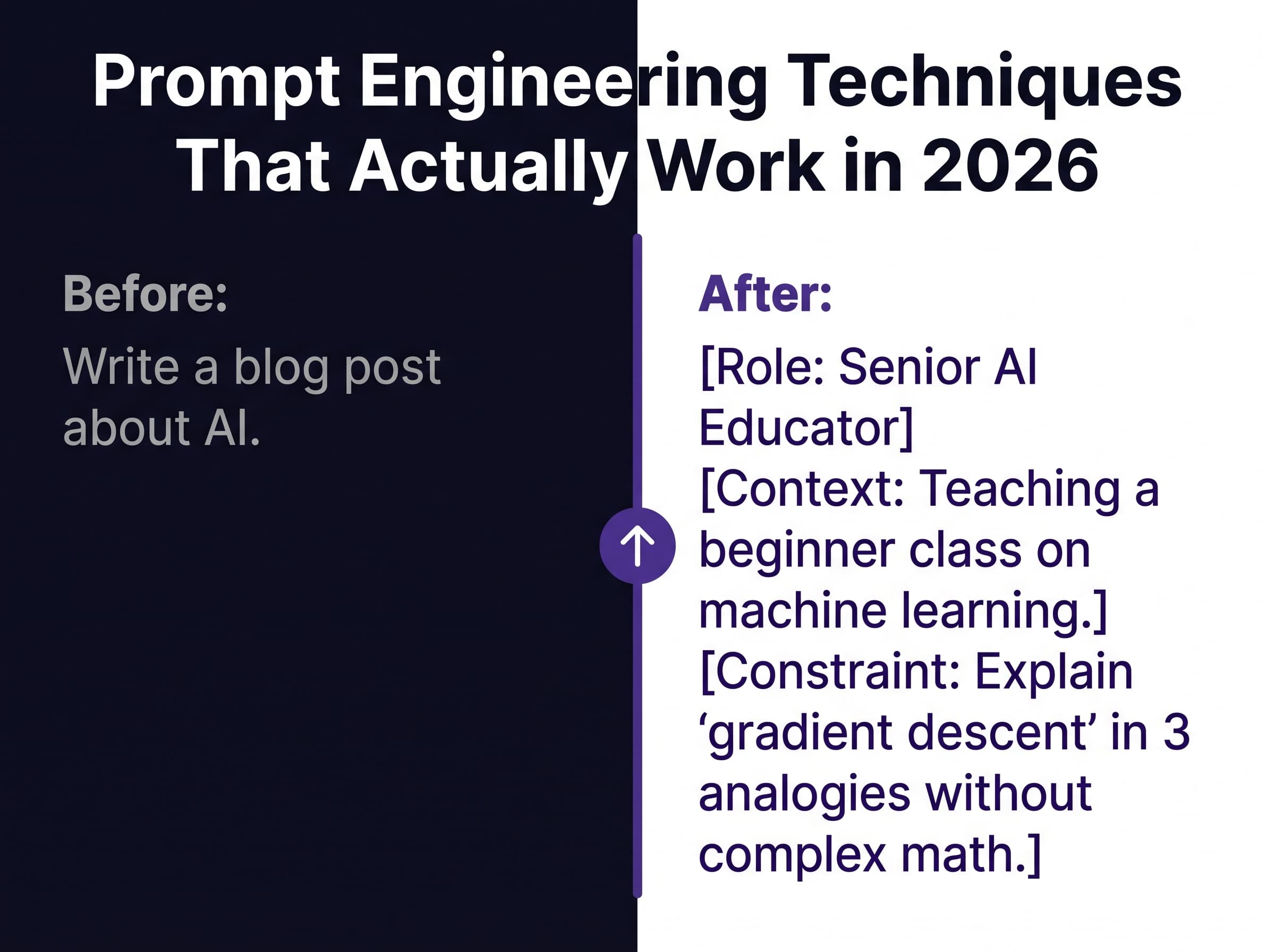
The Prompt Engineering Techniques That Actually Work in 2026 (Tested With Before and After Examples)
Research-backed prompt engineering techniques improve AI output quality by 20 to 60 percent on standardized benchmarks. These are the specific ones worth learning, with real before and after examples.
Claude vs ChatGPT vs Gemini: Which AI Model to Use and for What in 2026
Claude, ChatGPT, and Gemini are not interchangeable. Each has architectural strengths that make it genuinely better for specific task categories. Here is the honest 2026 breakdown.
The next prompt professor essay in your inbox.
One careful letter, every Sunday. Free.