Research-backed prompt engineering techniques improve AI output quality by 20 to 60 percent on standardized benchmarks. These are the specific ones worth learning, with real before and after examples.

The Prompt Engineering Techniques That Actually Work in 2026 (Tested With Before and After Examples) Research-backed prompt engineering techniques improve AI output quality by 20 to 60 percent on standardized benchmarks depending on the task category. The techniques that produce measurable improvements are a small, specific subset of what is being taught and circulated. These are the ones in that subset, with real before-and-after examples. Why Most Prompt Engineering Advice Does Not Work The prompt engineering space has significant noise-to-signal problems. Most circulating advice falls into one of three categories: techniques that worked with older model versions but are now irrelevant because the models improved, techniques that work in theory but produce negligible real-world benefit, and techniques that are genuinely effective but have been buried under the noise. The discipline has split cleanly in 2026 into two distinct practices: casual prompting, which most users can do adequately with minimal technique, and production context engineering, which is a genuine engineering skill producing compounding value across thousands of executions. The techniques below come from the latter category and are relevant to any user who uses AI daily for work. Technique 1: Chain-of-Thought Prompting Chain-of-thought prompting asks the model to show its reasoning steps before producing a final answer. For complex reasoning tasks, this technique consistently improves output accuracy because the reasoning process itself catches errors that would appear in a direct answer. When it works: multi-step problems, logical deductions, complex analysis requiring inference across multiple pieces of information, tasks where the reasoning process matters as much as the conclusion. When to skip it: dedicated reasoning models including o-series GPT models and Claude's extended thinking mode already perform chain-of-thought internally. Adding "think step by step" to a prompt for these models is redundant and sometimes counterproductive. Before: "What marketing channel should I prioritize for my ebook business?" After (chain-of-thought): "I want you to reason through this step by step before giving me a recommendation. My ebook business sells digital guides on prompt engineering for people who use AI daily for work. I currently have no email list and 2,000 Pinterest monthly views. I am considering investing time in either building an email list through lead magnets or increasing Pinterest posting frequency. Think through the strengths and weaknesses of each approach for my specific situation, then give me a clear recommendation with your reasoning." The after-prompt produces a reasoned analysis rather than a generic answer. The model engages with the specific situation before concluding. Technique 2: Few-Shot Prompting Few-shot prompting provides two to five examples of the desired output format before asking the model to produce new content. This technique is consistently more effective than describing what you want in abstract terms because the model pattern-matches from concrete examples faster and more accurately than it interprets abstract descriptions. When it works: any task with a specific format, tone, or structure that is easier to demonstrate than describe. Pin descriptions, email subject lines, product copy, social media captions, structured data extraction. Before: "Write Pinterest pin descriptions for my prompt engineering blog posts. Keep them under 500 characters and make them compelling." After (few-shot): "Write Pinterest pin descriptions for my prompt engineering blog posts. Here are two examples of the style, length, and tone I want: Example 1: Most people type a question and hope for the best. The people getting remarkable AI outputs use a five-part structure every time. The complete framework with before-and-after examples is on the blog at promptprofessor.estorealm.com Example 2: Claude, ChatGPT, and Gemini are not interchangeable. Using the wrong model for the task is the most common source of disappointing AI output. The honest 2026 model breakdown is on the blog at promptprofessor.estorealm.com Now write 5 pin descriptions in this exact style for these blog post titles: [list titles]" The examples remove the need to describe tone, length, format, and urgency in abstract terms. The model extracts the pattern directly. Technique 3: Constraint Stacking Generic outputs come from unconstrained prompts. Each constraint added to a prompt removes one degree of freedom the model would otherwise fill with a generic default. Stack four to five specific constraints simultaneously rather than relying on the model to infer appropriate limits. The four most impactful constraints:
Format constraint: the exact structure of the output Audience constraint: a specific description of who will read this Tone constraint: what register to use and what to explicitly avoid Exclusion constraint: specific phrases, approaches, or content to omit
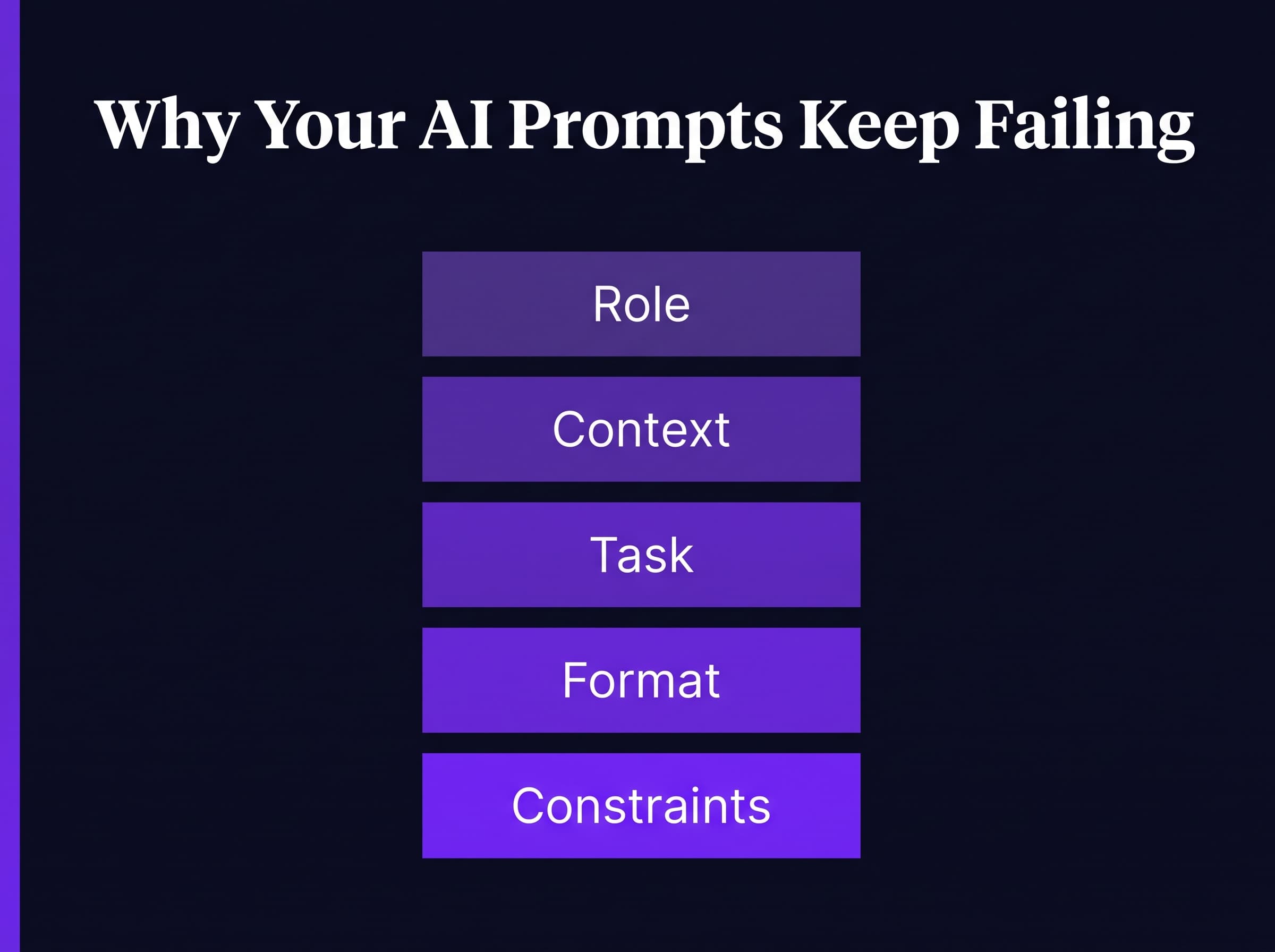
Before: "Write a social media post about context engineering." After (constraint stacking): "Write one LinkedIn post about context engineering for AI workflows. Format: three short paragraphs of two sentences each, followed by one call-to-action line. Audience: professionals who already use AI daily and want to use it more systematically. Tone: direct and confident, no hedging, no motivational language. Exclude: the phrases 'dive in,' 'it is important to,' 'game-changer,' and any emoji. Under 250 words total." Every constraint is a specification that the model would otherwise guess at. Guesses produce defaults. Specifications produce targeted output. Technique 4: Positive Framing Over Negation Positive framing consistently outperforms negation in AI prompts. Telling a model what to do produces more reliable results than telling it what not to do. Processing a negative instruction requires the model to activate the concept it is supposed to suppress before suppressing it. Negation (less effective): "Don't be too formal. Don't use jargon. Don't write long paragraphs." Positive framing (more effective): "Write in a conversational tone accessible to someone with no technical background. Use plain language throughout. Keep every paragraph under three sentences." Same intention. The positive version is executed more reliably because it describes the target state rather than the prohibited state. Technique 5: The Meta-Prompt When a prompt produces disappointing output, send this to the model: "I used this prompt and got mediocre results: [paste your original prompt]. Rewrite it using best prompt engineering practices. Add role, context, constraints, and format specifications. Then explain what you changed and why." The model rewrites your prompt and explains the improvements. This is the fastest available method for learning prompt engineering because every lesson comes from the specific output you were trying to improve. Example meta-prompt output: Original prompt: "Write a blog post about why AI prompts fail." Model-improved version: "You are a senior content writer for a prompt engineering education brand. Our audience consists of professionals who use ChatGPT, Claude, or Gemini daily for work and are frustrated by inconsistent output quality. Write a 1,400-word blog post explaining why most AI prompts produce mediocre output. Cover the literal-interpretation mechanism, the five-part prompt structure that addresses it (Role, Context, Task, Format, Constraints), and include one before-and-after example for each component. Use H2 subheadings. Short paragraphs of two to three sentences. Direct, expert tone with no hedging. End with a disclaimer that AI model behaviors evolve." The gap between those two prompts is the gap between a generic article and a targeted one. Technique 6: The Format Specification That Eliminates Post-Processing Specify the exact output format you need before asking for content. The output arrives ready to use rather than requiring reformatting. Without format specification: "Summarize this article." Output: a paragraph summary requiring reformatting for whatever use case it was needed for. With format specification: "Summarize this article in exactly this format: one sentence stating the main claim. Three bullet points of supporting evidence, each under 20 words. One sentence stating the practical implication for a content creator who uses AI daily. No other content." Output: arrives in exactly the form needed, usable immediately. The format specification adds 30 seconds to the prompt. It removes three to five minutes of reformatting from the output. Applied across a week of AI use, the compounded time saving is significant. Context Engineering: The Practice Behind All of These Techniques The 2026 term for what advanced prompt engineering has become is context engineering: designing the entire information environment the model operates in rather than crafting individual prompts. This includes what the model knows about you through persistent custom instructions, what knowledge it has access to through documents loaded into context, what tools it can use, and how outputs feed back into subsequent prompts. For individual users, the highest-leverage version of this is a single setup task: invest 10 minutes in writing a strong custom instruction for your primary AI tool. Specify who you are, your audience, your preferred tone and format, what the model should assume about your background, and what it should never do. This context applies to every subsequent interaction without being re-specified. The quality difference between a conversation with a well-constructed custom instruction and one without it is large enough that this single task produces more long-term output quality improvement than any individual prompt optimization. For a complete library of tested prompt templates organized by model and use case, and for the custom instruction frameworks used by daily AI power users, visit promptprofessor.estorealm.com. Frequently Asked Questions Which of these techniques produces the biggest improvement for most people? Few-shot prompting and constraint stacking consistently produce the largest measurable improvement for users currently writing unstructured prompts. The meta-prompt technique produces the most learning value because it teaches through your specific work. Do these techniques work for image generation prompts as well as text? Constraint stacking, positive framing, and format specification transfer directly to image generation prompts. Few-shot prompting works in multimodal models that accept image examples as input. Chain-of-thought is text-specific and does not transfer to image generation. How many constraints are too many? Four to six is the productive range for most tasks. Beyond eight, constraints can begin conflicting with each other, producing outputs that satisfy all requirements individually while missing the actual intent. Specify what matters most, not everything possible. Is chain-of-thought still relevant when newer models reason better automatically? For standard models, yes. For dedicated reasoning models (o-series, Claude extended thinking, Gemini thinking mode), the reasoning is already happening internally and adding "think step by step" adds noise rather than value. Know which type of model you are using before applying this technique. What is the single change that would most improve my AI output quality today? Write a strong custom instruction or system prompt for your primary AI tool and apply it to all conversations. Specify your role, your audience, your preferred tone and format, and what you never want the model to do. The compounding effect of consistent context across all interactions exceeds the benefit of any single prompt optimization. What is context engineering and how is it different from prompt engineering? Prompt engineering focuses on crafting individual prompts for specific tasks. Context engineering designs the entire information environment the model operates in — persistent instructions, loaded knowledge, available tools, and how outputs feed subsequent inputs. Context engineering is the 2026 evolution of prompt engineering at the production level.
This article is for educational purposes only. AI model behaviors and capabilities evolve rapidly. Test all techniques with your current model versions and specific use cases.
More from Prompt Professor
Claude vs ChatGPT vs Gemini: Which AI Model to Use and for What in 2026
Claude, ChatGPT, and Gemini are not interchangeable. Each has architectural strengths that make it genuinely better for specific task categories. Here is the honest 2026 breakdown.
Why Your AI Prompts Keep Producing Mediocre Output (And the Fix That Works Every Time)
Vague prompts produce generic output because AI models fill every gap you leave with the most statistically common answer in their training. One structural fix changes everything.
The next prompt professor essay in your inbox.
One careful letter, every Sunday. Free.