Claude, ChatGPT, and Gemini are not interchangeable. Each has architectural strengths that make it genuinely better for specific task categories. Here is the honest 2026 breakdown.

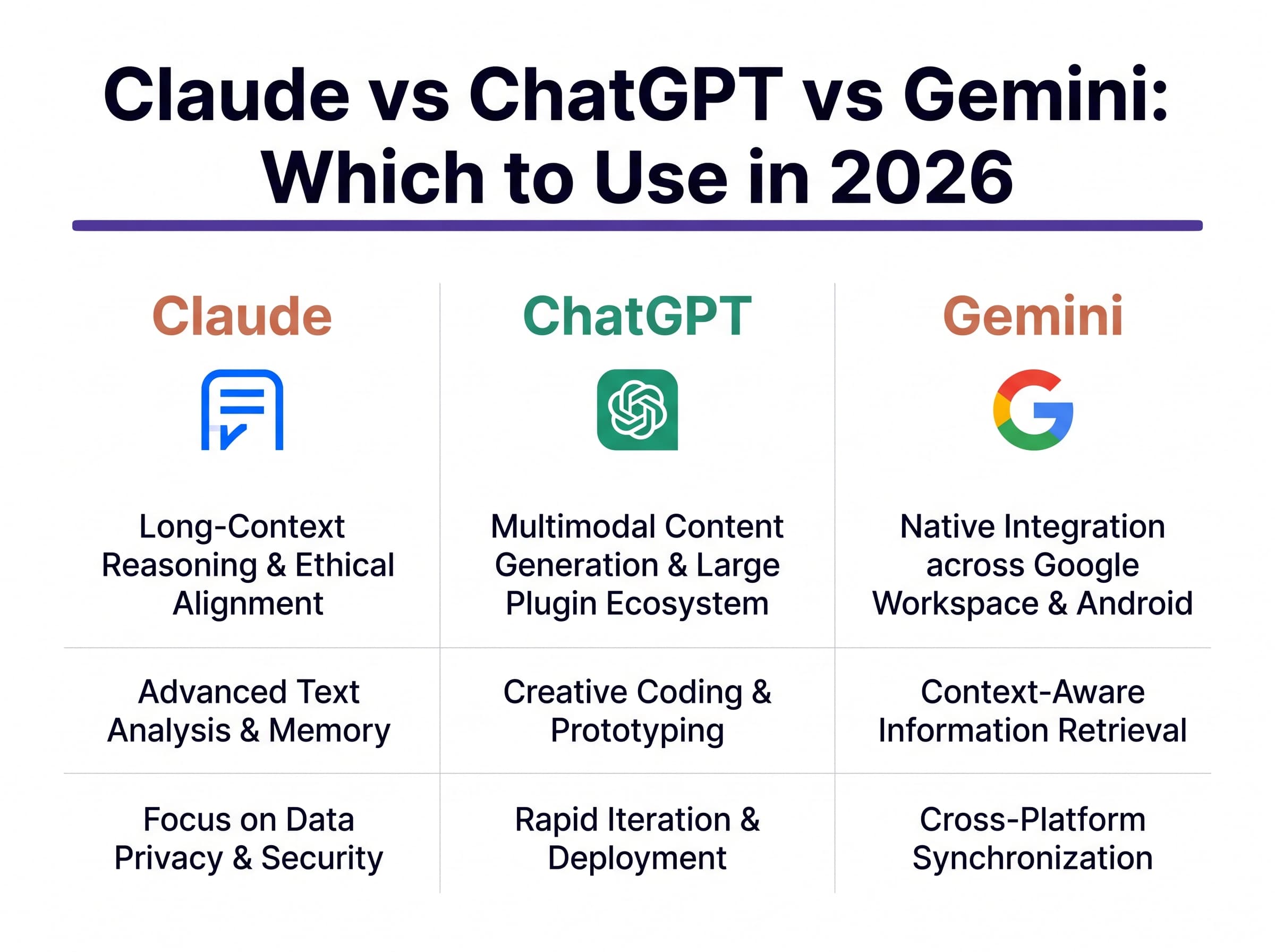
Claude vs ChatGPT vs Gemini: Which AI Model to Use and for What in 2026 Claude leads on long-form writing quality, instruction following, and long context tasks. ChatGPT leads on tool ecosystem breadth, multimodal accessibility, and creative flexibility with ambiguous prompts. Gemini leads on Google Workspace integration and real-time search grounding. The correct model is determined by the task category, not by a single overall ranking. Why the Models Differ The differences between frontier AI models in 2026 are not primarily about which is smarter in a general sense. They reflect different training priorities, different fine-tuning choices, different context window architectures, and different design philosophies about what the model should optimize for. A model optimized for instruction-following precision produces different outputs than one optimized for conversational flexibility. A model with a 200,000-token context window handles long-document tasks differently than one with tighter context management. Understanding these structural differences tells you where to route each task before you type a single word. Claude: Where It Leads Long-Form Writing and Reasoning Claude consistently produces the highest-quality long-form written output of the three publicly available frontier models. The writing maintains structural coherence across long documents, holds a consistent voice without the repetitive phrasing patterns that appear in GPT output at length, and produces reasoning that follows a logical architecture rather than generating text that sounds logical while containing internal contradictions. For anything that requires a long-form piece that needs to hold together as a single coherent argument — a detailed analysis, a long article, a structured report, a complex document — Claude is the correct choice for most writing-focused users in 2026. System Prompt Reliability Claude follows system prompt instructions more consistently than the other frontier models. For developers and power users building AI workflows, this matters significantly. Instructions placed in a system prompt to govern behavior across an entire conversation or application are more reliably executed by Claude than by GPT or Gemini equivalents. Long Context Window Tasks Claude's ability to maintain coherent attention across very long context windows makes it the strongest choice for tasks involving reading and reasoning across long documents: an entire manuscript, a long legal contract, a research paper, or a large codebase. Claude reads all of it rather than anchoring to the beginning and end. Instruction Following With Structure Claude responds particularly well to prompts structured with XML tags. Wrapping different components in explicit tags like <role>, <task>, <context>, and <constraints> produces more precise output from Claude than equivalent unstructured prompts. This is a documented design preference, not a workaround. ChatGPT: Where It Leads Breadth of Tool Integration GPT models through the ChatGPT interface have the broadest native tool ecosystem of any publicly accessible AI platform. Code execution, image generation, web browsing, file analysis, and third-party integrations are all more mature and more accessible through ChatGPT than through Claude's consumer interface. For users who need to move quickly between generating images, running code, searching the web, and producing text within a single workflow, ChatGPT's tool integration provides the most frictionless experience available. Multimodal Tasks at Consumer Level GPT-4o and its successors handle multimodal inputs including images, audio, and documents with strong accessibility at the consumer level. Uploading a photograph for detailed analysis, transcribing and summarizing audio, or working with visual documents is smoothest through the GPT interface for most non-developer users. Creative Writing With Ambiguous Prompts GPT models handle ambiguous creative prompts more comfortably than Claude, producing usable creative output even when instructions are incomplete. Claude's instruction-following precision makes it slightly more literal with underspecified creative prompts. For rapid creative ideation where perfect prompt construction is not the priority, GPT is often the faster path to usable material. Gemini: Where It Leads Google Ecosystem Integration Gemini's primary advantage for most users is its native integration with Google Workspace. Analyzing documents in Google Docs, pulling data from Google Sheets, summarizing Gmail threads, and working within the Google productivity environment is something Gemini does that neither Claude nor ChatGPT can match with the same depth of native access. Real-Time Information Access Gemini's access to real-time web information through Google Search integration is deeper and faster than the search capabilities of other consumer AI products. For tasks where current information is essential and timeliness matters, Gemini's Google Search grounding is a practical advantage. Mixed-Content Long Documents Gemini 1.5 Pro and subsequent versions combine a very long context window with strong multimodal capability. For tasks that involve reasoning across long documents containing images, charts, tables, and mixed content types simultaneously, Gemini's multimodal-long-context combination is competitive. The Model Selection Framework Use Claude when:
You are writing something long that needs to hold together as a coherent whole You need a system prompt followed precisely across a long session You are analyzing a long document and need the model to read all of it Your prompt is well-structured and you want precise instruction execution The quality of the final written output is the primary success criterion
Use ChatGPT when:
You need integrated tool use within a single workflow You are doing creative brainstorming with underspecified prompts You need accessible multimodal capabilities without developer setup The breadth of the GPT plugin and function ecosystem matters for your task
Use Gemini when:
Your work lives primarily in Google Workspace You need real-time search grounding with deep Google integration Your task involves reasoning across long mixed-content documents You are a Google Cloud enterprise user with native Gemini workflow integration
Multi-Model Workflows The highest-leverage insight for advanced AI users in 2026 is not choosing one model and becoming loyal to it. It is routing tasks to the correct model from the start and using multiple models deliberately for different stages of the same project. A common high-output workflow: use ChatGPT for rapid multimodal brainstorming and initial research, move to Claude for long-form writing and precise instruction execution, and use Gemini for real-time fact-checking and Google Workspace integration. The models do not share memory between platforms, so context must be re-established when switching, but the quality trade-offs can make the switch worthwhile for high-stakes outputs. For model-specific prompt templates and tested examples showing exactly how to structure prompts for each model's preferences, the full library is available at promptprofessor.estorealm.com. Frequently Asked Questions Is Claude better than ChatGPT overall in 2026? Neither is better overall. Claude leads on long-form writing quality, instruction following, and long context tasks. ChatGPT leads on tool ecosystem breadth, multimodal accessibility, and creative flexibility. The correct answer is entirely determined by the task category. Does using a more expensive model tier always produce better output? Not always. A well-structured prompt sent to a mid-tier model often outperforms a vague prompt sent to the most capable model available. Model tier matters less than prompt quality until the task is complex enough that reasoning depth becomes the genuine bottleneck. Should I use multiple AI models for the same task? For high-stakes outputs, yes. Different models produce different failure modes, and comparing two independent outputs from different models often reveals weaknesses that either alone would not surface. How often do model rankings change? Frequently. The frontier model landscape changes on a scale of months. Specific benchmark rankings are unstable. The structural differences in design philosophy between models are more stable. Use the category-based framework above rather than point-in-time benchmark scores. Can I switch models mid-project without losing quality? Yes. Starting with ChatGPT for rapid brainstorming and moving to Claude for final long-form execution is a legitimate and often high-quality workflow. Re-establish context explicitly when switching because the models do not share memory across platforms.
This article reflects model capabilities as of July 2026. AI model performance evolves continuously. Test all comparisons with your specific tasks and current model versions.
More from Prompt Professor
The Prompt Engineering Techniques That Actually Work in 2026 (Tested With Before and After Examples)
Research-backed prompt engineering techniques improve AI output quality by 20 to 60 percent on standardized benchmarks. These are the specific ones worth learning, with real before and after examples.
Why Your AI Prompts Keep Producing Mediocre Output (And the Fix That Works Every Time)
Vague prompts produce generic output because AI models fill every gap you leave with the most statistically common answer in their training. One structural fix changes everything.
The next prompt professor essay in your inbox.
One careful letter, every Sunday. Free.